What's new in 2026? HyperASHS!
HyperASHS is an all-new version of ASHS. It does much more than the original: it produces isotropic-resolution segmentations, it runs in the cloud through ITK-SNAP or locally on a GPU workstation, and its T2w + T1w and T1w-only models use a unified protocol. HyperASHS is described in our new paper in NeuroImage: Li et al., 2026.
Get started with HyperASHS ASHS Classic documentation
What is ASHS?
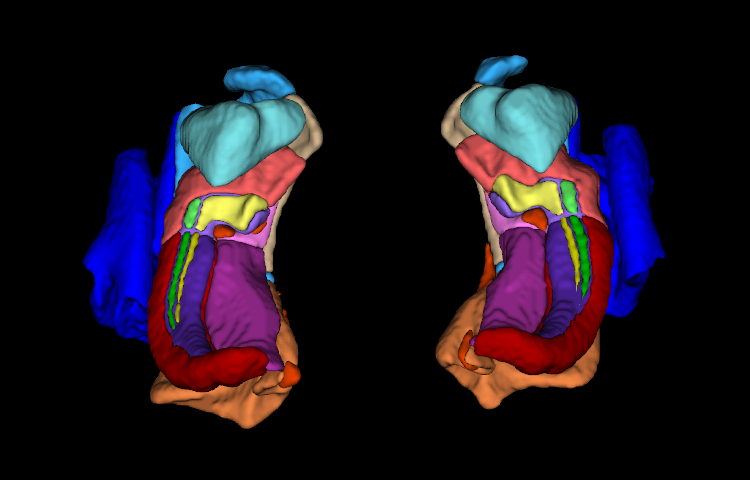
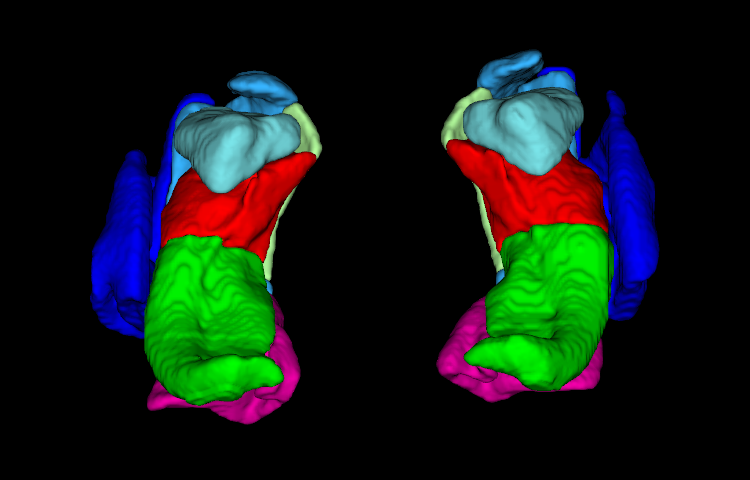
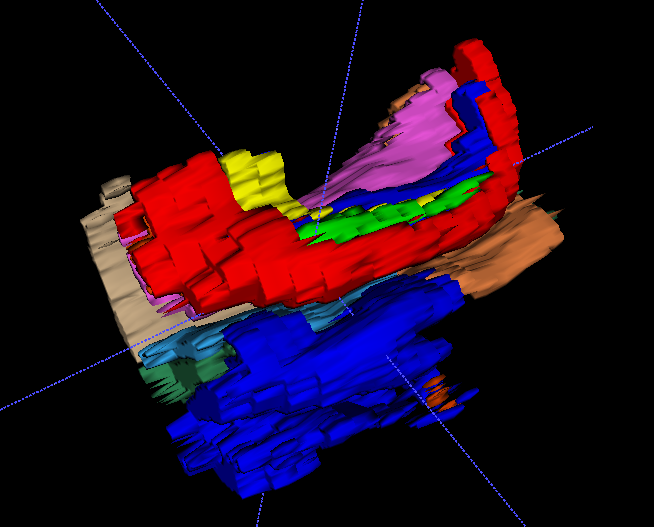
ASHS is software for automatic segmentation of the medial temporal lobe (MTL) substructures in brain MRI scans. These structures are involved in early Alzheimer's disease and in a number of other neurological conditions. They are also important in research on memory and cognition.
- Automatically labels hippocampal subfields in T2-weighted MRI, or anterior/posterior hippocampus in T1-weighted MRI
- Automatically labels subregions of the MTL cortex, including entorhinal, perirhinal and parahippocampal cortex, in both T1-weighted and T2-weighted MRI
- Can be retrained to use your own segmentation protocol
- Free, open-source software
Which version should I use?
HyperASHS (recommended) uses deep learning (nnU-Net) trained on isotropic, upsampled atlases. It produces segmentations at ~0.4 mm isotropic resolution and takes about 3 minutes per subject on an NVIDIA GPU. It runs in the cloud through ITK-SNAP, or locally after pip install hyperresashs.
ASHS Classic uses multi-atlas segmentation with joint label fusion. Its segmentations have the resolution of the T2w MRI. It runs in the cloud through ITK-SNAP, or locally on Linux and MacOS, and has been used in many published studies and in ADNI.
Use the HyperASHS / ASHS Classic switch at the top of every page to move between the two sets of documentation.
About us
ASHS and HyperASHS are developed by members of the Penn Image Computing and Science Laboratory (PICSL) in the Department of Radiology at the University of Pennsylvania. Please see Citations for the papers to cite, and join the mailing list for updates and help.
Funding
Research reported on this website was supported by the National Institutes of Health under award numbers R01-AG056014, R01-AG037376, and R01-EB017255. The content is solely the responsibility of the authors and does not necessarily represent the official views of the National Institutes of Health.